A Fragmented Economy Could Disrupt AI Displacement
An argument for supporting small businesses as a way to protect jobs as companies adopt AI.
By the NYUP Opinion Team
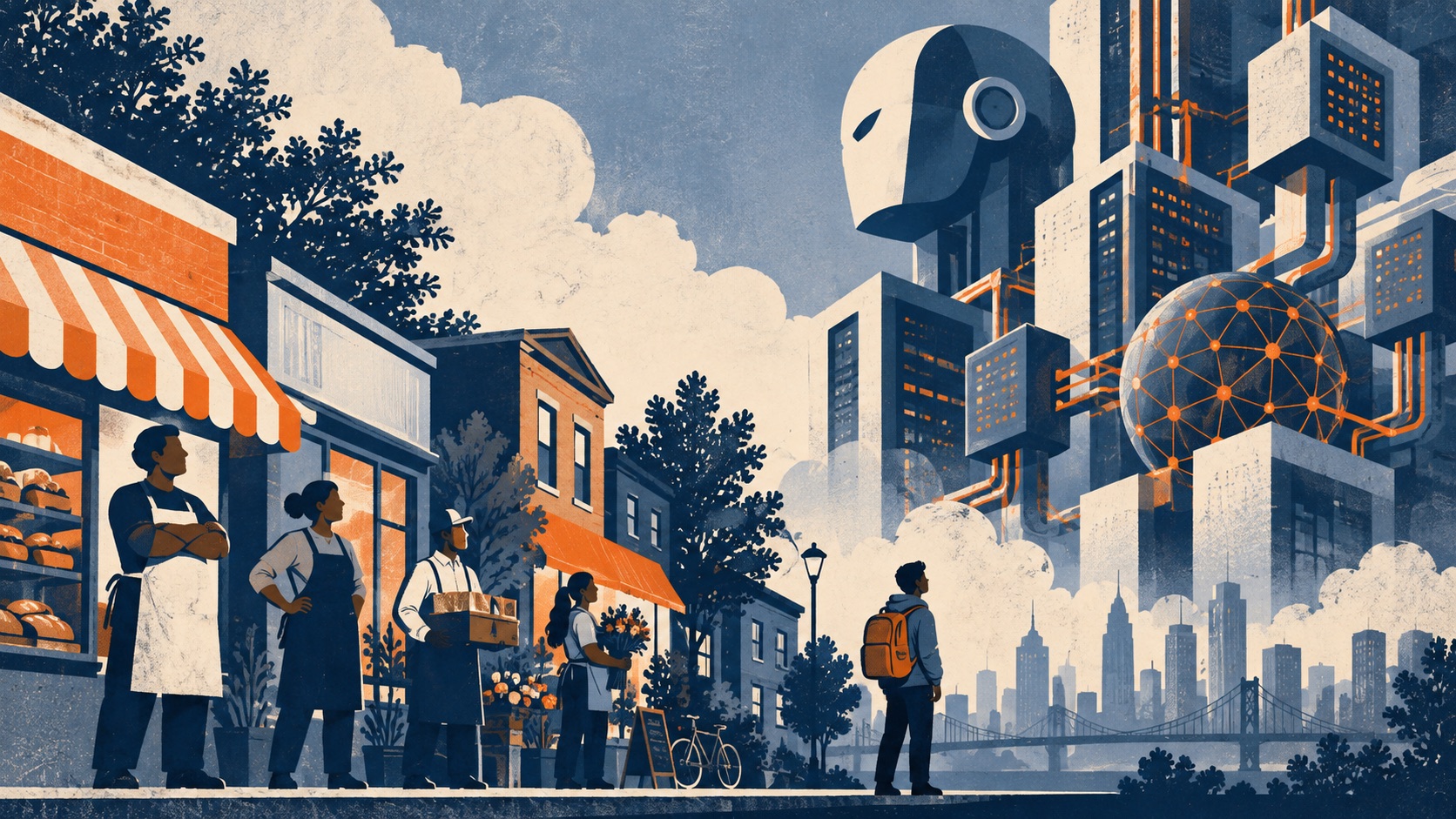
Most solutions to protect the workforce from AI focus on protections for the individual. Popular ideas include job training programs, wage insurance, universal basic income, expanded unemployment benefits, and tax benefits for human labor. While these solutions are not flawed, they all increase the extent to which Americans rely on the government for economic stability. I question whether this will be a successful long-term solution. If AI truly can create an abundance of everything and humans no longer have to work, then maybe we can have a system of universal income where everyone is comfortable. More likely, this utopia will not become a reality, and if it does, it will take hundreds of years for it to arrive. A safer bet is to prepare for a world where many lose their jobs, but work is still necessary, and unemployment remains a fear. In this world, the government must continue to support upward economic mobility. This can be done by supporting local businesses that rely on human connection and innovation rather than larger corporations that are quicker to prioritize efficiency.
Inside a Walmart, some of the sections include a grocery section, an electronics section, a pharmacy and health section, a fishing section, a sports section, a clothing and apparel section, a toys section, a hardware section, and a lawn and garden section. While not every Walmart is the same, most Walmart Supercenters are around 180,000 square feet (Walmart Inc., 2014) and have just about everything someone could need. There are currently 4,615 Walmarts in America (Walmart Inc., 2026a). They represent the perfect model of corporate efficiency, and each one is tightly run to maximize profits. In many small towns, Walmart is the largest company and outcompetes local small businesses (Kenton, 2026). In fact, Walmart grew by targeting small rural areas where they could quickly grow to dominate local industry. Many of the largest cities in America don't even have a Walmart (Lackmeyer, 2026). In Louisiana, which has the country's 49th-ranked economy (Lackmeyer, 2026), there are 137 Walmart locations and Walmart is the state's largest employer (World Population Review, 2026). However, throughout those Walmarts, there are 37,465 workers who have an average wage of 18.24 dollars per hour (Walmart Inc., 2026b). While Walmart seems to be benefiting rural locations by raising the tax base and employing locals, the potential for Walmart employees to reach true wealth and comfort is low. The average wage of all Walmart workers in America is around 30,000 dollars. The Walton family, meanwhile, owns around 45 percent of Walmart and is worth around 500 billion dollars (Walmart Inc., 2026c). As AI progressively becomes more advanced, the Walton family will cut jobs if it means adding another billion to their profits.
Imagine one of those small towns in Louisiana, but now there is a small fishing store, a new grocery market, 3 new clothing stores, a computer store; you get the concept. The 500 billion of the Walton family would become fragmented and create a new class of American millionaires.
On the worker side, small businesses can offer job security. In 2026, 116,175 U.S. job cuts have cited AI (Challenger, Gray & Christmas, 2026), the leading reason in America. However, a recent study by the Bipartisan Policy Center found that small businesses operate on thinner margins and lack the deep technical integration required to fully substitute human labor with autonomous systems (Malde, 2026). Many others in the AI literature expect smaller companies to lay off fewer employees because of AI automation. Small businesses have fewer funds to invest in leveraging AI for efficiency, and human labor has greater staying power. The social connection between a small business owner and their employees is also greater than the one between chains of leadership in large corporations, where financial motivations are more likely to outweigh social factors. Two studies of French employment data, conducted by Bassanini, Breda, Caroli & Rebérioux (ILR Review, 2013) and Sraer & Thesmar (2007), found that family firms have lower dismissal rates, lay fewer workers off after economic shocks, and to downsize they rely on hiring freezes rather than dismissals. Additionally, large firms are currently using AI at rates around 40 percent while small firms remain around 10 percent (OECD, 2025). Large corporations such as Meta (8,000), Oracle (21,000), Salesforce (4,000), and many others have begun to replace employees with AI automation on a large scale.
From a larger systematic standpoint, small businesses are key to keeping the economy fragmented. The last 100 years have marked the rise of a globalized, centralized economy which has driven innovation and economic growth while simultaneously destroying local economies. Over the last 50 years, many of America's small towns have lost the industrial businesses that powered their growth throughout the 20th century, as companies moved operations overseas where production costs are lower. This has led to the rise of rural decay: local banks are almost nonexistent, infrastructure has not been upgraded, and industries such as agriculture have been consolidated. The study — Dube, Lester & Eidlin, "Firm Entry and Wages: Impact of Wal-Mart Growth on Earnings Throughout the Retail Sector" — found that per new Walmart store, at the county level:
- Retail earnings fall 0.5% to 0.9% on average
- General merchandise wages fall 1%
- Grocery store employee earnings fall 1.5%
- Combining wage and employment effects, total county retail earnings fall about 1.5% per store
Corporate superpowers have crowded out local economies, and while in the current model many large corporations still employ thousands of Americans, as time goes on, in the apocalyptic AI scenario which many Americans fear, one or two large corporations may capture control of the economy and with those monopolies begin to automate away human labor, centralizing all growth in an extremely concentrated bubble. By ensuring the health of smaller economic institutions, levers of economic mobility and stability can be protected.
The secondary effect of sending money to support smaller businesses and economic institutions is that the money is more likely to stay local and benefit others in the surrounding community. Local retailers return roughly 52% of revenue to the local economy; chain retailers about 14%; local restaurants recirculate about 79%; chains about 30%; roughly $0.45–$0.68 of additional local output per dollar is spent locally, versus ~$0.14 at a chain (Mitchell, 2012). Even more, if children with low-income parents grow up in counties with the economic connectedness typical of high-income children, their adult incomes are about 20% higher on average (Chetty et al., 2022). Upward mobility is transmitted through cross-class relationships, showing how an even distribution of wealth can lead to derivative effects that support the broader community.
Now, how do we do this? The first thing that must be done is to ensure that existing businesses and institutions are able to survive. The rise in private equity and its ability to financialize almost every aspect of society has led to many local ventures being bought up to maximize profits, therefore hurting local consumers. A key reason behind this is that nearly half of private businesses are owned by people at or near retirement, employing 32 million workers, and many owners don't have a succession plan (Project Equity, n.d.), so businesses close or get absorbed into firms with no local anchor. The most popular and effective way of fighting this issue has been to subsidize businesses as they transition ownership from the founder to a group of current workers. Bills such as the Employee Equity Investment Act provide funding to help companies transition to ESOPs, which stands for an Employee Stock Ownership Plan. In an ESOP, workers all receive shares of a company, and the owner slowly divests and dilutes their shares. Typically, a company takes out a loan to pay its owner for their shares and then distributes those shares over time to the workers in the company. Then, they take a portion of profits and use those profits to pay back the loan. However, the government can instead either cover the loan or give out loans with no interest. The ESOP model is extremely effective at offering owners an alternative to selling out to private equity. It also helps to change the ownership structure to one that is significantly more worker-friendly. One of the strongest critiques of capitalism is the flaws in the ownership structure, with vastly disproportionate amounts of profit being funneled to a small group of owners in a given company. The ESOP helps to spread profits throughout a large group of workers and distribute wealth in a more equal manner.
The most basic way to help local institutions grow is through direct investment. Current initiatives such as Rural Business Development Grants, Rural Microentrepreneur Assistance Program, and Business & Industry Guaranteed Loans provide government funding in the form of low-interest loans or direct payments. Other programs such as the Chips and Science Act are contingent on reaching a goal such as manufacturing semiconductors in the Chips and Science Act.
Additionally, the revival of antitrust and price discrimination enforcement can ensure AI efficiency does not result in extreme outcompetition. Only in the last five years has the federal government begun to consider reviving foundational legislation such as Robinson-Patman, which has lain dormant for many years. Robinson-Patman, for example, prevents price discrimination. Paired with support for small businesses, the government can work to even the playing field. I am not proposing to eliminate large corporations, but rather take away their ability to dominate suburban and rural economies that have lost their own longstanding economic institutions.
Businesses become even more valuable going forward because of what AI can and cannot do. While it will replicate hard skills such as coding a database or programming a robot to cut a piece of wood, humans will retain much of their labor value through social skills and innovative qualities. Entrepreneurship will continue to be the most effective way of creating wealth. The government needs to make sure that Americans not only have the funds to start a company, but also that there is room for their company to exist. AI will never be able to create a company itself, but the trap humankind risks falling into is a small group of companies commanding the power of AI and taking over supply chains, blocking others from leveraging it. The government needs to work with Americans to create an economy reliant on Americans rather than a country reliant on the government.
References
- Bassanini, A., Breda, T., Caroli, E., & Rebérioux, A. (2013). Working in family firms: Paid less but more secure? Evidence from French matched employer-employee data. ILR Review, 66(2), 433–466. https://doi.org/10.1177/001979391306600206
- Challenger, Gray & Christmas, Inc. (2026, September). Challenger report: August 2026. https://www.challengergray.com/wp-content/uploads/2026/09/Challenger-Report-August-2026.pdf
- Chetty, R., Jackson, M. O., Kuchler, T., Stroebel, J., Hiller, A., Oppenheimer, S., & Opportunity Insights Team. (2022, August). Social capital and economic mobility: Non-technical research summary. Opportunity Insights. https://opportunityinsights.org/wp-content/uploads/2022/07/socialcapital_nontech.pdf
- Kenton, W. (2026, June 17). Understanding the Walmart Effect: Impact on local economies. Investopedia. https://www.investopedia.com/terms/w/walmart-effect.asp
- Lackmeyer, S. (2026, April 15). Walmart's journey from "Mr. Sam" to a global giant. USA Today. https://www.usatoday.com/story/news/usa250/2026/04/15/walmarts-journey-from-mr-sam-to-a-global-giant/89093970007/
- Malde, J. (2026, April 22). AI and the workforce: Impacts on jobs, workers, and employers. Bipartisan Policy Center. https://bipartisanpolicy.org/issue-brief/ai-and-the-workforce-impacts-on-jobs-workers-and-employers/
- Mitchell, S. (2012, August 16). Independent businesses deliver bigger economic benefit, study finds. Institute for Local Self-Reliance. https://ilsr.org/article/independent-business/independent-businesse-deliver-bigger-economic-benefit/
- OECD. (2025). AI adoption by small and medium-sized enterprises: OECD discussion paper for the G7. OECD Publishing. https://doi.org/10.1787/426399c1-en
- Project Equity. (n.d.). Small business closure crisis: The Silver Tsunami of retiring business owners. https://project-equity.org/impact/silver-tsunami/
- Sraer, D., & Thesmar, D. (2007). Performance and behavior of family firms: Evidence from the French stock market. Journal of the European Economic Association, 5(4), 709–751. https://doi.org/10.1162/JEEA.2007.5.4.709
- Walmart Inc. (2014). Walmart U.S. store types. https://media.bizj.us/view/img/2981041/wmt-cm-art-board-store-types-nm-sup-051214-opt-b.pdf
- Walmart Inc. (2026a). Location facts. Walmart Corporate. https://corporate.walmart.com/about/location-facts
- Walmart Inc. (2026b). Walmart in Louisiana. Walmart Corporate. https://corporate.walmart.com/about/location-facts/united-states/louisiana
- Walmart Inc. (2026c). 2026 proxy statement. https://stock.walmart.com/_assets/_5813cf69129ed45d080396680f549a44/walmart/db/950/9988/proxy_statement/2026+Proxy+Statement.pdf
- World Population Review. (2026). Largest employer by state 2026. https://worldpopulationreview.com/state-rankings/largest-employer-by-state