By Wendell Sweet
When examining the political divide in America, a key issue is that of the Electoral College. Since the Constitution was ratified, the idea of state equality has been a major point of conflict in politics, with conservatives often fearing an abuse of urban power. This was the ideology behind the Electoral College. But, while created to strengthen America’s democracy, the Electoral College is now weakening it. Although the ideals behind it are admirable, the Electoral College is an outdated system that policymakers often ignore, claiming it to be less important than other pressing issues. In a Stanford Magazine article, the author made the argument that, “Almost no one would adopt an Electoral College today if we were starting from scratch. But reforming the Electoral College does not rank high among our national problems.” This is a worrying line of thinking; America’s democratic process should not take a backseat to other policy issues.
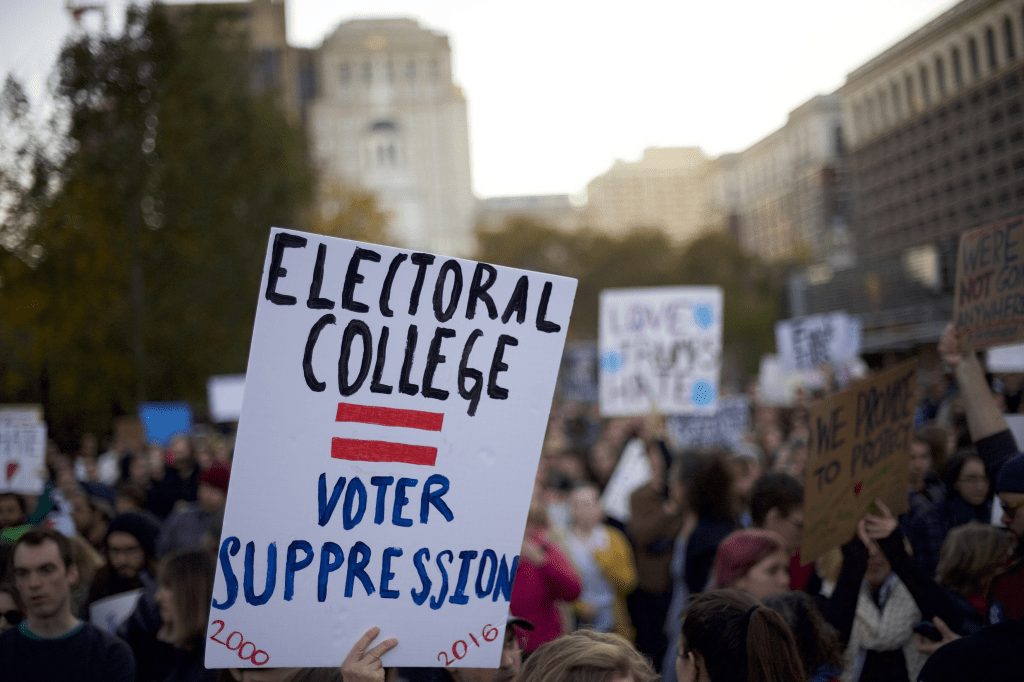
A Pew Research survey found that over 63% of Americans support abolishing the Electoral College. Many Americans feel that the system is failing to give them the voting power they deserve. Take South Dakota, for example. After the 1964 election, the state has voted for a Republican nominee in every presidential election. Around a third of South Dakota registered voters are Democrats, yet their vote has continually been overpowered by the large Republican bloc in the state. It goes both ways; as a teenager, I see my peers not voting because New York consistently votes Democrat. They see no visible impact from their vote in election outcomes, and therefore don’t even register to vote. This is the core of the argument against the Electoral College; it goes against the values of liberty and equality as to which America leans so heavily on. Whether a popular vote, the Electoral College, or a representative democracy is put in place, there will be flaws. What must be determined is which system does the best job at equally distributing voter power.
The Electoral College was created at a time when states and the federal government were clashing over how to balance power; it was formed to help protect smaller states from being overpowered by large urban areas. Electoral votes are determined by adding up a state’s number of senators and House of Representatives seats. This means that in small states, voters get more individual voting power than in larger states. The smallest state by population, Wyoming, has almost 5 times as much voting power per individual compared to the largest state by population, California. The way I figured this out was by dividing California’s electoral votes (54) by its population (39 million). I then did the same thing with Wyoming. When calculating electoral votes, as states rise in population, the voting power per individual lessens, displaying the inequality of the Electoral College.
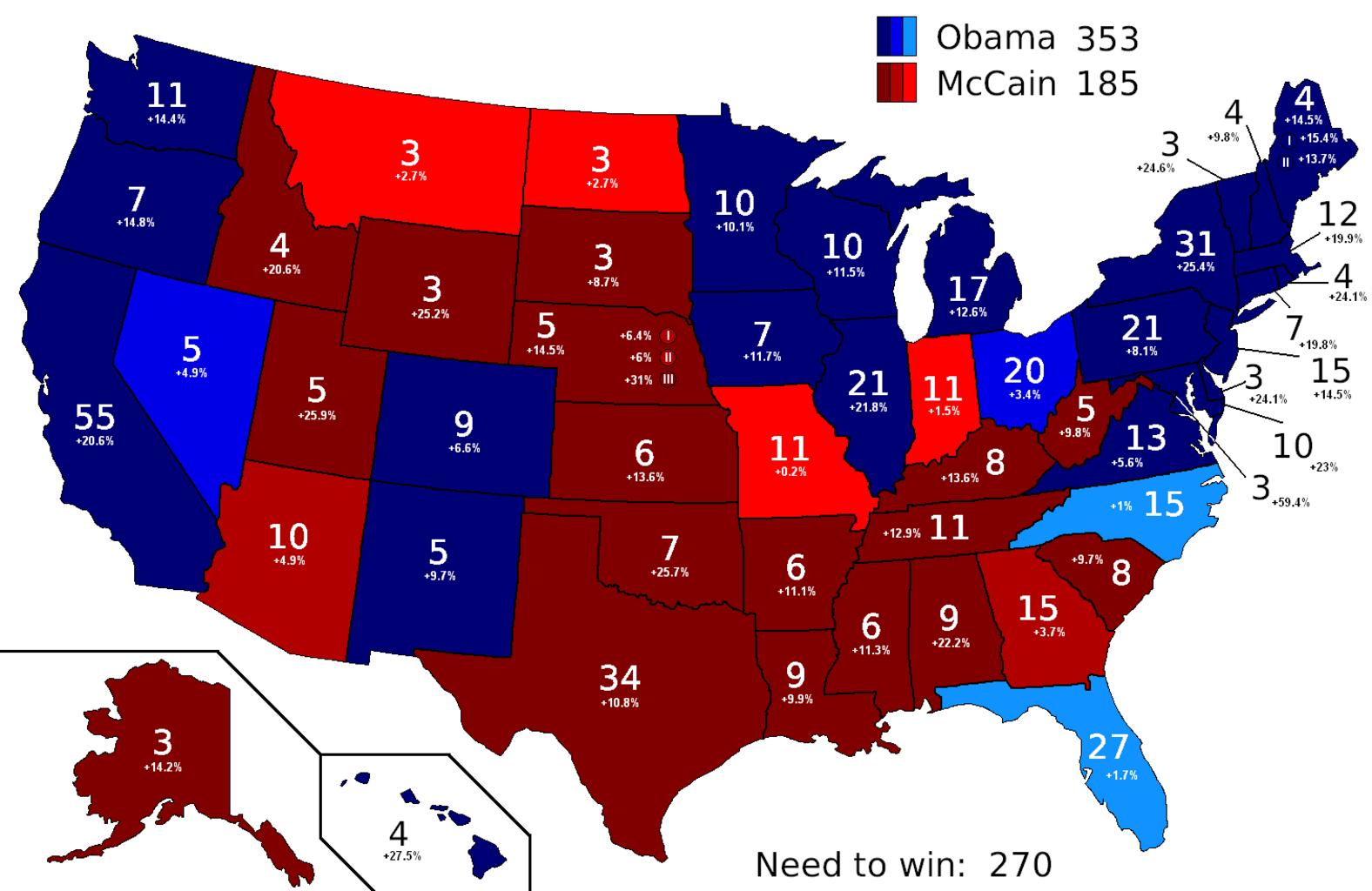
The founding fathers, at least, thought this was warranted. As of the 2020 Census, approximately 80% of the U.S. population lives in urban areas, with 20% in rural areas. This indicates the potential of rural interests to be crowded out by those of urban areas. There was a fear that politicians would tailor their policies to cater to large urban blocs and therefore ignore key parts of the country. Regional favoritism could potentially come into play, and large parts of America would be ignored. There are many issues with this perception. The first is that while politicians may not be changing their positionsw to benefit those in high-density population areas, they are instead making concessions and changes to benefit “swing states” to win a given election. In the 2024 election, many considered Pennsylvania, Michigan, Wisconsin, Georgia, North Carolina, Arizona, and Nevada as the key “swing states.” Those states consequently received 1 billion out of 1.3 presidential ad spending, equivalent to over ¾ of total spending. Donald Trump and Kamala Harris were not at fault for this. Strategically, it made the most sense to maximize spending in those areas; what must be questioned is the system that made this situation possible. In a popular vote, spending and campaigning would encompass a broader group of people and voices. While attention would still disproportionately favor areas with the most undecided voters, the campaign trail would encompass a wider range of places. There would be no clear strategy for how to best win the most voters over. It should be expected that in whatever system is put in place, candidates will be so desperate to gain control that they will sacrifice stances on policy to gain voters, but by eliminating the Electoral College, the extent to which this issue impacts a given election will be much diminished.
The second flaw with this argument is that even if rural voters have less power in a straight-up popular vote, that does not mean policy will evolve to crowd those people out. Agriculture is essential to America’s economy and lifestyle, and politicians inevitably will prioritize its development. Even more, whether the electoral college or a popular vote is used, urban populations will still vastly outweigh everybody else. In the example I mentioned earlier, despite Wyoming giving individual voters five times as much voting power as voters in California, they still received 51 fewer electoral votes. California, as an industrial and urban hub, still overpowers the more conservative and rural Wyoming. This is not to say that rural interests are being ignored, but the point is that no matter what, rural votes will be a small piece of the pie and the electoral college does not have a meaningful impact on that balance to justify the way it weakens America’s democracy. The last issue with this thinking is that small states do not have uniform interests or political views, and neither do large states. Instead, political affiliations have remained geographically divided for much of America’s history. We do not live in a political atmosphere in which small states and large states face off in political conflict; instead, it is the conservative south and middle of America up against the more liberal northern coastal areas.
What makes the Electoral College an outlier is the fact that over the last 100 years, almost every democracy in the world and even non-democracies have abandoned any resemblance of the electoral college and moved to adopt a popular vote. Additionally, the president and the vice president are the only federal officials not elected by a direct popular vote. Not only are there inconsistencies within our own country, but also on a worldwide scale. If it truly is such a good system, why is it only used for one race? Congressional elections, and every other key election in the county use a simple popular vote.
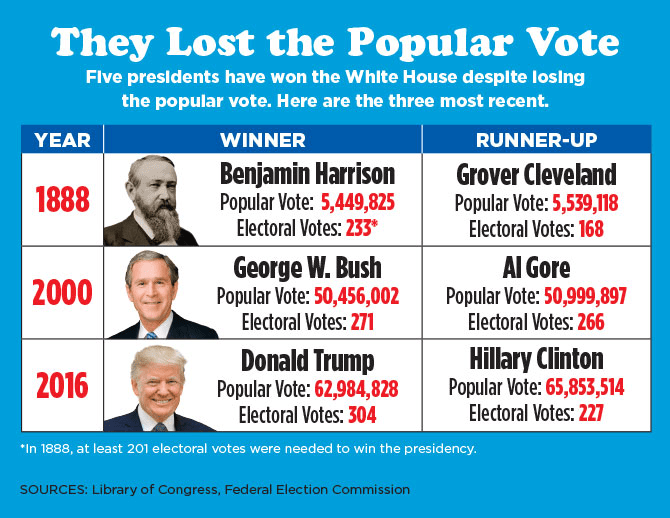
The most important defense that can be made for the electoral college is that it simply makes the voting process more equal. There have been 5 times in American history when a president has been elected while losing the popular vote, with the largest loss coming in 2016 when Donald Trump won the presidency while garnering 2.9 million fewer votes. As a country that prides itself on its values of liberty and equality, how is it possible for a presidential candidate to win while receiving millions fewer votes? This contradicts the appeal of the democratic model. The idea of “rule by the people” is diminished when candidates can win elections with fewer overall votes. Every vote should be made equal, and for one’s geographic position to determine their voting power is unjust.
There are other benefits that come with the introduction of a popular vote. One is that abolishing the Electoral College would open the possibility for a third candidate to make a run at the presidency, giving more options to American voters. Since 1850, there has not been a non-Democrat or Republican elected, and grassroots movements are often overshadowed by mainstream candidates. While this is not solely because
of the Electoral College, it certainly does not help that in the electoral system, votes won in a state only matter if they are the majority won in that state.
Additionally, this system would compel more Americans to engage in the election and educate themselves about the political sphere. A study from the U.S. Chamber of Commerce Foundation found that over 70% of Americans fail a basic quiz on civic literacy. At a time in which social media has led to the spread of misinformation, a larger emphasis on voting would force Americans to become more politically involved.
The one challenge would be an extremely close election, with candidates calling for a recount. Rather than having to focus on an individual state, every vote in the country would potentially be up for review. While this is worrying, in a country with almost 200 million registered voters, the odds of the margin between the candidates being small enough to warrant a recount are very small. The last time the margin was less than a million votes was the year 2000, when George Bush won the election but still lost by around 500,000 votes. In most cases, one candidate wins by millions of votes, and even at a margin of hundreds of thousands of votes, the result should not be in question. Secondly, if all rules are followed, a recount should not be challenging to undergo. The issue is that repeatedly, voting centers across America have made mistakes such as not updating the voter registration list or miscounting votes. Leaving a clear audit trail and making sure to form clear, transparent procedures will help reduce the potential for confusion over the result of an election.
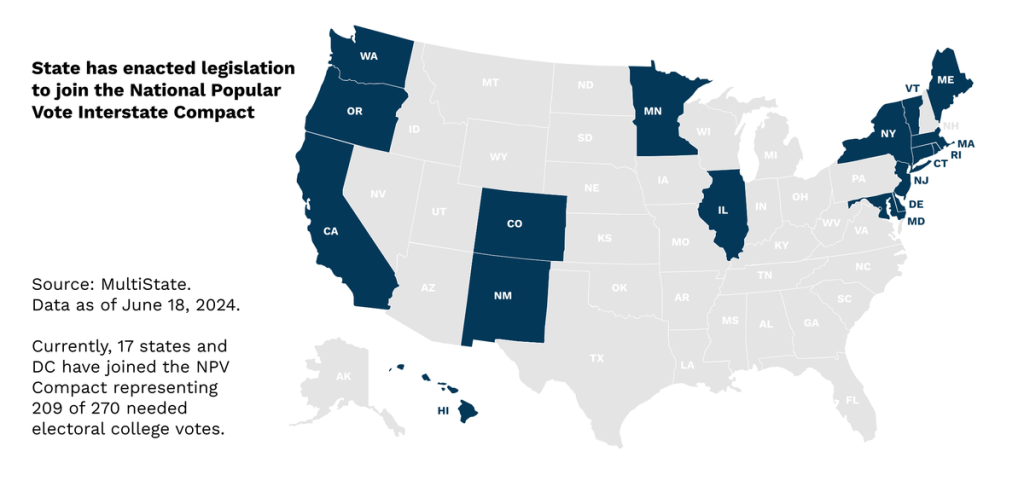
For a popular vote to be implemented, there are 2 routes that can be pursued. As of 2026, 18 states and the District of Columbia have signed on to the National Popular Vote (NPV) Interstate Compact. Those 18 states make up 222 electoral votes. In this agreement, states agree to send all of their electoral votes to the winner of the popular vote. Once the number of states in the agreement combines for over 270 electoral votes, the United States will essentially become a popular vote. However, although the fact that 18 states have signed on may seem encouraging, the reality is that the states currently part of the NPV Interstate Compact are mostly liberal states that were expected to support moving towards a popular vote from the beginning. The challenge lies in obtaining the 48 remaining electoral votes, which will have to come from moderate and conservative states. This process has already been going on for 20 years, and it could be another 30 years before we see the NPV Interstate Compact reach its goal of 270 electoral votes. Additionally, a change in leadership could lead to a state pulling out of the agreement, and the NPV is not as sustainable as amending the constitution. This would require 2/3 of both the House and Senate to approve the amendment, along with 3/4 of state legislatures (38 states) to ratify it. It is improbable that a popular vote can be ratified unless a large bipartisan group of politicians can come together in agreement that the popular vote would be beneficial to America’s democracy. The founding fathers feared political division, and for that reason, they designed the Constitution so that it could only be changed by a politically unified government.
Clearly, the benefits of the popular vote outweigh the harms, and the problems that come with the popular vote are better to have than those that come with the electoral college. The real barrier to achieving this change and other legislative progress is the gridlocked nature of Congress and America’s political sphere. Many small states and swing states do not want to give up political power, even if it creates a more democratic America. There is a constant power struggle in American politics, and it is holding the country back from equalizing a process that has been unequal for too long.
 The New York Unity Project
Leave a comment